Translate

Saturday, April 28, 2012

Next Week's Moon Signs

 Here are a few tips for those who are interested in gardening by the moon.

After noon on Saturday, April 28, the moon is in Leo. This sign is barren, dry, and fiery. Because the moon is waxing, don't get too carried away with mulching, weeding, cultivating, or spraying, unless something is an emergency. The results could be disappointing. Be careful about pruning with the moon in Leo, unless you want something to die. This would be an excellent time to catch up on activities that do not directly affect planting or pest control. If you need more raised beds, make them now. You can even mix your soil and get the beds ready for planting. If you need trellising or protective covers, now's the time to make them. If you need to remove rocks from your garden, you could do that now too. Otherwise, just leave your garden alone. Go focus on hobbies or interests unrelated to agriculture. Studies show that seeds planted in Leo tend to do very poorly. This coming week will bring you more favorable days for starting seeds and transplanting.

In the early morning hours of April 29, the moon enters the second quarter.

Monday, April 30, at 7:02 pm the moon enters Virgo. This sign is also considered barren, and is usually used for cultivation and destroying weeds and pests. But since the moon is still waxing, don't bother with these activities unless you have a situation that is getting to be a problem. Continue on the same projects suggested above, with the moon in Leo.

The moon enters Libra after dark Wednesday night, May 2. Libra is semi-fruitful, moist, and airy. Use for planting crops that need good pulp growth. Things like celery, rhubarb, lovage, and farm crops such as hay and corn fodder should be seeded now. This is also a very good sign for flowers and vines, to emphasize fragrance and beauty. Trim or mow to increase growth. If you have vegetable plants that are outgrowing their pots, you can go ahead and transplant them now, though there will be a more favorable sign coming right up!

Scorpio will be the next constellation that the moon visits, starting late Friday evening (May 4). Scorpio is very fruitful and moist, almost as productive as Cancer, and emphasizes sturdiness. Saturday, May 5, is going to be the last day to plant above-ground crops for the next two weeks, because the moon enters the third quarter Saturday night. In other words, full moon occurs then. This is the day you want to really focus on getting your last seeds and transplants out if you live in Arkansas. If you live in the northern USA, you should wait until May 20 to transplant your frost-susceptible vegetables, unless you plan to cover them up. Plant annuals which produce their crops above the ground, generally of the kind that produce their seed inside their fruit. Some examples include beans, eggplant, melons, peas, peppers, pumpkins, squash, tomatoes, etc. This is just general advice, not any hard-and-fast rule. Many plants seem to do equally well whether planted in either the first or second quarter, such as watermelons, hay, corn, and grains. Now is the time to fertilize, graft, and irrigate. Trim to increase growth.

Blessings to all!

This Week In Pictures

Our old-fashioned fragrant rose bush is in full bloom, and shedding fragrance far and wide.

Here I attempted a picture of the entire row of irises. It didn't turn out so well, except for the girl at the other end!

Forget-Me-Nots starting to get really pretty! Thank you, Sister Anna!

A few more pretty shots of the irises.


Peas blooming.

Yukon Gold potatoes doing well.

Elizabeth's personal rose bush. Pretty in pink!

Zucchini squash blooming in the early morning. Some squash forming on the vines now!

Repelling Rascally Rabbits

A friend of mine that planted a garden this spring had pretty much the whole thing wiped out by some raiding rogue rabbits. I have never had that problem, but I'm trying some of the suggestions below to keep cats out of my raised beds. I will let you know how they work. In the meantime, take your pick of any one of these measures and give it a shot. Be sure to let me know how they work! Post your comments in the box at the bottom of this blog. I have already tried Repels All granules (by Bonide) to keep the cats away. My cats didn't care. Almost seems as if my one cat doesn't have any sense of smell left! It's a mix of dried blood, egg, and garlic, and is supposed to be repulsive to a wide range of animals. I got it at our local Tractor Supply store.

Jerry Baker
The following solutions are from Jerry Baker. He is said to be America's foremost authority on lawn, garden, and plant care and has written over 50 books, including the bestsellers Backyard Problem Solver, Kitchen Counter Cures, and Supermarket Super Products! All of Jerry's books are jam-packed full of old-time advice, down-home wisdom, and the best remedies on earth. For more of his amazing tips, tricks, and tonics, visit his website at: www.jerrybaker.com.

Solutions
Rabbits HATE dusty millers, scientifically known as Centaurea cineraria. Especially the variety known as Diamond, which is one of the prettiest. Plant some of these among the vegetables that are at high risk. Also try planting onions or garlic as a companion to the victims. Tansy, rue, and rosemary are also repellants.


Dusty Miller var. Diamond

Sprinkle some dried blood or blood meal around the plants. Most garden centers carry this, because it is sold as a natural fertilizer. So you can use it to serve a double purpose. Shake wood ashes, ground pepper, chili powder, talcum powder, or Cayenne pepper on plants when they are wet, applying them evenly and lightly with a discarded kitchen flour sifter.

All Purpose Varmint Repellant
2 eggs
2 cloves of garlic
2 Tbl. of hot chili pepper
2 Tbl. of ammonia

Put all this in 2 cups of hot water. Let the mixture sit for 3 or 4 days in a bucket, then paint it on fences, trellises, or wherever else unwanted varmints are venturing.

'Hit The Trail' Mix
4 Tbl. of dry mustard
3 Tbl. of cayenne pepper
2 Tbl. of chili powder
1 Tbl. of Tabasco sauce
2 quarts of warm water

Mix all together, and sprinkle the solution around your plants. Jerry says this spicy concoction will make any critter hightail it out of your garden.

Hot Bite Spray
When furry munchers are after your plants, whip up a batch of this timely tonic:
 3 Tbl. of cayenne pepper
1 Tbl. of Tabasco sauce
1 Tbl. of ammonia
1 Tbl. of baby shampoo
2 cups hot water

Mix the cayenne pepper with the hot water in a jar, and shake well. Let it sit overnight, then pour off the liquid without disturbing the sediment. Mix the rest of the ingredients in with the liquid and spray directly on the plants you want to protect.

You get the idea. Most of these recipes work because of the 'heat' of the hot peppers. Garlic really works well for most critters as well. I don't have a recipe handy right now, but you could just follow your instinct and come up with your own. Other ideas worth a try are to string up strips of aluminum foil around your at-risk area. Cut strips of foil 1 inch by 5 inches and tape them to a string of some sort around the perimeter of your plants. If you want to try blood meal, put some in cheap containers (spray can caps are perfect) sunk into the ground around your plants. In each cap mix 2 Tbl. of blood meal and 2 oz. water. This keeps the blood meal from washing away with the first rain, and also prevents your plants from getting a nitrogen overdose because of your critter control efforts.

The recipes listed here are not only for rabbits, but should work equally well for most other garden raiders such as deer, chipmunks, squirrels, groundhogs, and as far as the garlic and pepper goes, even dogs and cats! Let me know how they work!

Blessings to all!

Wednesday, April 25, 2012

Why Raised Beds Are Better (And How To Make Them)

If you've already used raised beds and had less than grand results, or you're just convinced you don't have the time or energy to make them, please hear me out! Read at least this one more post before you decide it's not for you. This is not traditional raised bed gardening, although some of the benefits I'm about to list also apply to traditional raised beds. Here are some reasons why Mel Bartholomew's raised beds are better.

Benefits Of Square Foot Gardening
Less Space - In a traditional garden, at least half of the space is used up just to walk on. Yet you plow it, you till it, you fertilize it, you water it, and you have to weed it! Just to walk on it! What a waste! With raised beds, you don't walk on them at all. The entire bed is used for planting. One 4x4 raised bed will hold 64 corn plants 6 inches apart, the same amount as you would normally put in a 30 foot single row. Most single rows are 2 1/2 to 3 feet wide (between rows) which means each 30 foot row takes up 75 to 90 square feet of space! With raised beds, that same amount of corn is raised in 16 square feet of space. Because you don't count the space you walk on.
No Tiller - You can sell your tiller. You don't need it anymore. Since you won't be walking on your garden, there won't be any of that compaction that's so bad for the plants. In fact, the only tool you really need is a cheap planting spade.
Less Fertilizer - And it takes less fertilizer. Mel Bartholomew says it doesn't take ANY with his special Mix. It's true that a steady supply of fresh compost provides a steady supply of nutrients, but so far I've still done better with adding some organic fertilizer. But at least you're only putting it on the planted area instead of where you walk!
Less Water - Once again, you're only watering the planted area instead of where you walk. And our special Mix is designed to stay moist a long time, and yet not become water-logged.
Less Weeding - The kids are going to love this one! Our special Mix can be made with no weeds in it (we'll discuss that in more detail later). Even with weeds, you have only a quarter of the space to weed compared to a traditional garden. And you don't have to hoe them. The soil is so light and loose they just come right up when you pull on them.
Depth - In Mel's first book 'Square Foot Gardening' he tells you how to dig deep and add peat moss and compost to the existing soil. I remember helping (or mostly watching) my Mom do that when I was about 5 or 6 years old. While this does greatly improve almost any soil, people said there was still too much back-breaking labor involved. So with further experimentation, Mel discovered that it isn't necessary to go that deep at all. In fact, most garden vegetables do just fine in only 6 inches of Mel's mix. You might want to have a few deeper boxes on hand for carrots and similar root vegetables, or use tubs or buckets. But for the main garden, use 2x6s. Everything I've seen so far had incredible root systems using this rich, loose mix that we'll show you how to make. I had some onions last winter in Mel's mix, and when I pulled them up in the spring some of them had roots 18 inches long!
Location - You can put it anywhere. You don't have to hide it behind the house. You can put it on rocky, barren ground, on pavement, or on your deck. If your roof is flat, you could put it on your roof! And your garden doesn't have to all be in one spot. If some of your crops want more shade than others, put them in a shady spot while the rest of the garden enjoys the sunlight.
Convenience - If you ever have to move, you can take your garden with you! You can bag the soil (it's a very special soil, after all) or, if you have lots of it, load it on a pickup. If you give your boxes a plywood bottom you can move your plants into your garage to protect them from frost or hail.

Making Your Raised Bed
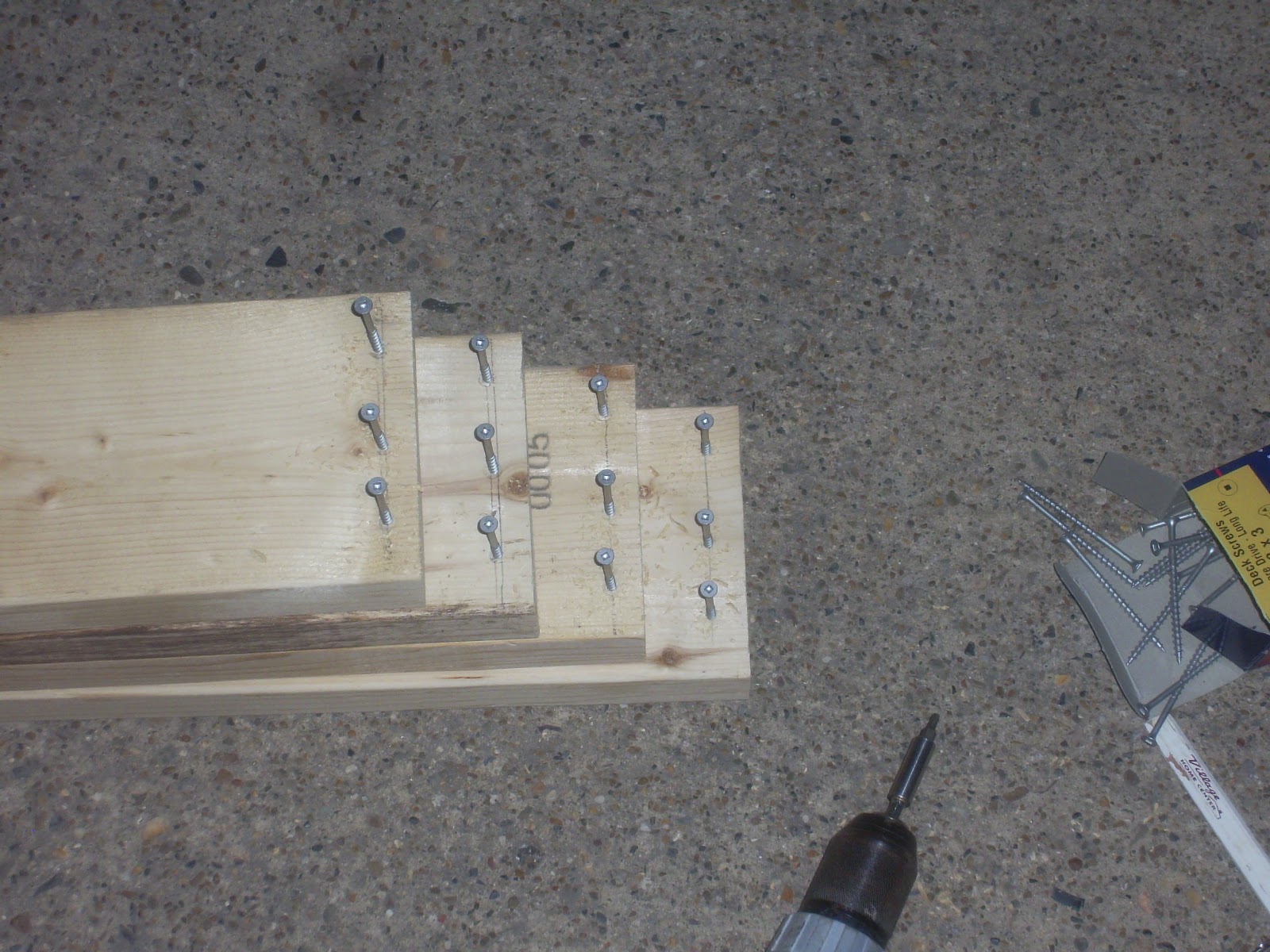
Here's how to make a 2x2 raised bed for the children. Remember, start small. You can always expand later. For a 2 foot square box, you need one 2x6, 8 foot long. You can get those at our local Lowe's Home Improvement store for just over $4.00 plus tax. Any cheap 2x6 will do, as long as it's untreated. Do NOT use treated wood, because of the risk of chemicals leaching into your soil and the plants taking them up. Regular untreated wood will last a number of years. If you would rather, you can use cedar or redwood for a more permanent bed. Or make it out of composite material (that man-made stuff made with plastic and sawdust). It'll last forever. Usually there's someone in the store that will cut your boards into whatever size you want if you ask them to. For the 2x2 you need four pieces of wood 2 foot long. Drill holes in one end of each board to keep them from splitting when you screw or nail them together. A 1/8 inch or slightly smaller drill bit is perfect. Draw a line 3/4 inch from the end of the board, then drill your holes along this line, one about an inch from either side and one in the middle.

If you're going to use screws, use 3 inch deck screws. Insert all of them into the pilot holes now (you'll need 12 screws or nails for each bed). If you're going to use nails, don't go smaller than 12d. If one side of the board is nicer than the other (as many are), then turn the nicer side up at this point. If you're going to stack the boards like I did, start putting the screws in the bottom board first so they don't get in your way as you proceed.
Now lay the boards out as shown and fasten them together.
And that's the frame. So simple, and yet so profound. If you're going to give it a plywood bottom, now's the time to do that. Remember to drill some drainage holes in the plywood. Use a half inch drill bit and drill a hole in each square foot. If you don't do plywood bottoms, then lay out some other kind of weed barrier. Around here, we have some very aggressive crabgrass which if it gets started will spread through your box like a spider web! If you're on concrete or pavement or wood, you'll be fine. Otherwise, you can use plastic. I do most of mine in plastic simply because I have plenty of it. I do know of a few weeds though that can grow through plastic. They send up a sharp spear that pierces right through it. Or use some good quality weed barrier (don't use the cheap kind from Walmart, it only lasts a few months and doesn't do a good job in keeping weeds down anyway). One of the best things to use is old carpet. Carpet readily lets excess water drain out and is superb at blocking weeds. You can even use it for your walkways, and if you don't like the looks of it, just add some decorative gravel or wood chips or whatever you find cheap or attractive. Carpet stays down well and will last for years.

Location
Besides needing decent lighting, put your garden in a convenient place. Close to a water supply. Not too far from the house so you can make a quick trip out to get some salad greens. You might want to put it where you can easily see it from a main window; for one, to enjoy the beauty; and also, so you'll be more likely to notice if any critters are showing too much interest in it. If you DON'T have a plywood bottom in it, be careful about getting it too close to trees or shrubs or they will grow their roots right into it and rob you of precious water and nutrients. Also, don't put your garden boxes where a lot of water runs through when it rains. You'll lose precious soil from washing. And you don't want them in low spots where water tends to puddle a lot. Plants need good drainage.

Cats
Just one word of advice before we move on. If you have cats, or someone in the neighborhood has cats, consider having a piece of chicken wire handy to lay on the raised bed right after you put the soil mix in. Cats and dogs love loose soil to dig in, and cats especially will think you made it just for them! Cats are like that. Dogs can be trained to a certain extent, but I've never yet been able to train a cat to not do something that they want to do. Chicken wire will discourage them and keep order until your plants are up. When your seedlings are established and the cats understand that this place is off limits you can lift the chicken wire right off the young plants without harming them. Or you could just leave it on for the season and let the plants grow right through it! On my next post I want to share some recipes you can use to teach intruders to leave your plants alone.

Spiritual types coming soon.
Blessings to all!

Saturday, April 21, 2012

Next Week's Moon Signs

Here are a few tips for those who are interested in gardening by the moon.

Today the moon is in Taurus, and for the next two weeks it will be in the waxing stage, getting bigger and bigger as it heads toward the full moon. This two-week period would be the correct time, especially in this part of the world, to finish planting all the rest of your above-ground crops. Of course, if you have something you want to stagger the harvest for, you can still do another planting in May so it doesn't all ripen at the same time. There is a higher likelihood (if you live in central Arkansas) that your May plantings will not be as successful on account of high heat or drought which is common around here during part of the summer (not always the same part, so it's impossible to predict with any accuracy). In this first quarter, focus on planting annuals of the leafy kind, generally which produce their seeds outside the fruit. Some examples are asparagus, broccoli, brussels sprouts, cabbage, cauliflower, celery, cress, endive, kohlrabi, lettuce, parsley, spinach, and sweet corn. Cucumbers, even though they bear their seeds inside their fruit, also do best if planted in the first quarter. Also plant grains at this time. If you won't be able to do any planting next week, then go ahead and finish all your planting either before Monday noon, or during the moon's passage through Cancer later in the week. Trimming or mowing now will stimulate growth. Planting in Taurus increases hardiness in annuals.

The moon enters Gemini at 1:05 in the afternoon on Monday, April 23. Gemini is considered barren, dry, and airy, and is generally used for destroying noxious weeds and pests, and for cultivation. Since the moon is in the first quarter, however, the effectiveness of these activities will be compromised. Do it anyway if the situation demands it. If you have any planting left to do, hold off if possible until the moon is in Cancer.

In the early morning hours of Thursday, April 26, the moon slips into the sign of Cancer, which is fruitful and moist. This is considered the most fertile of all the signs in the Zodiac. With the moon still in the first quarter, keep your focus on planting annuals of the same kind as we mentioned above. We will plant the kinds that produce their seed inside their fruit next week when the moon is in the second quarter. Now is also a good time to fertilize, to irrigate, or to graft plants. Trim or mow to stimulate growth.

Shortly after noon on Saturday, April 28, the moon passes into the constellation Leo, and remains there through the rest of the weekend. Leo is barren, dry, and fiery, similar to Gemini above. Because the moon is waxing, don't get too carried away with mulching, weeding, cultivating, or spraying, unless something is an emergency. The results could be disappointing. Be careful about pruning with the moon in Leo, unless you want something to die. This would be an excellent time to catch up on activities that do not directly affect planting or pest control. If you need more raised beds, make them now. You can even mix your soil and get the beds ready for planting. If you need trellising or protective covers, now's the time to make them. If you need to remove rocks from your garden, you could do that now too. Otherwise, just leave your garden alone. Go focus on hobbies or interests unrelated to agriculture. Studies show that seeds planted in Leo tend to do very poorly. Next week will bring you more favorable days for that.

Blessings to all!

This Week In Pictures

These went from completely green to fully ripe in one week! And they are so good! Yes indeed, I ate one right after taking the picture.
Zucchini squash are blooming. We're anxious to see them set fruit.
Peas are just starting to bloom. They disappointed us again - so far.
Made 2-ft.-square raised beds for the children to have their own personal square foot garden. Filled them with Mel's Mix, modified to my specifications. I know, I haven't posted instructions yet. That's coming up next!
Matthew eagerly helping Momma plant tomatoes.
The iris bed is probably at its prettiest right now. Thanks again to Karen Koenig!
 
And this one is my favorite! The camera didn't do justice to the color.


Gardening Made Easy

Maybe you think you don't have room for a garden. Maybe you think you don't have time or the energy for a garden. Maybe the only sunny spot you have is on your deck, or on your driveway, or on some barren, rocky corner which would be impossible to convert into a conventional garden. If so, what I'm about to share will greatly broaden your horizons. Because what I want to show you makes it possible to have a beautiful and very productive garden on your deck or patio, on your driveway, or (seriously) some people do it on their roof for lack of a better place (a flat roof works best, of course)! We're going to make it really, really easy to give your garden all the light and water it needs (provided you don't actually live in the forest), and just the right kind of soil. As you might have guessed, this is a combination of both raised beds and container gardening. And yet it's not entirely either one.

Square Foot Gardening
There's a man named Mel Bartholomew that spent years looking for ways to make it easy for everyone to have a garden. If you have read his book "Square Foot Gardening" you already know the general direction I'm taking. If you have his second book "The All New Square Foot Gardening" you have an even better idea of where we're going. His "All New" method is what I started in with, and made a few modifications to better suit our climate here in central Arkansas. In his "All New" book he makes several major improvements over his first book, as a result of his on-going research and experimentation. Mel calls his method 'square foot gardening.' He advocates making your gardens four foot square, although they can be different shapes and sizes. He says that one 4x4 raised bed will supply enough produce to make a salad for one person every day of the growing season. One more 4x4 box will provide the daily supper vegetables for that one person. And just one more 4x4 box will supply that person with extra of everything for preserving, giving away, special crops, etc. And a 3x3 box will do the same for a child as a 4x4 does for an adult (if you count the square feet within a 3x3 you'll find it is just over half as big as a 4x4).

Start Small
Because I am trying to make it possible for school children to have a garden, I recommend starting in with a 2 foot by 2 foot box. If someone knows nothing at all about gardening (or that person is maybe only pint-sized), a 2x2 is very manageable. True, it won't produce your supper every day of the season, but after experiencing a 2x2 you will have a much better idea of how much you can handle and how many square feet you need to raise the quantity you would like. Start in small. The same principals that I'm about to share can be applied to a 3x3, a 4x4, or a 2x8, or whatever size you want to make your garden. For those that already know they're going to do more than a 2x2, let me give you a few words of advice here. Never go more than four foot wide. That is all the average person can reach comfortably. Anything wider than that will have you or somebody else placing a hand or foot on the soil in the box for support in order to reach the middle, causing unhealthy compaction. If your beds are going to be up against a fence or a wall, don't go more than 2 foot wide (that's the same distance as to the middle of a 4x4). Never make a bed larger than 4x12. If you do, I guarantee somebody will try to step across it instead of walking around it to the other side, and end up in the middle of your garden! If you plan to put more than one 'garden' in the same area, be sure to allow plenty of room in between. Two feet for the aisle width is rarely enough. It might seem like enough when you build the box, but you will very likely have plants cascading over the sides, and it could easily end up being impossible to pass between them without trampling them. Go a bare minimum of two and a half feet for the aisle. I make mine three feet to make it easy to pass through with a wheelbarrow.

In my next post, I want to show you exactly how to make your box, so we can get started with the best gardening experience you've had yet!

Click here to see spiritual types.
Blessings to all!